Anxiety and Overthinking
“What if something goes wrong?”
“Should I have handled that differently?”
“I just need to figure this out.”
“Why can’t I stop thinking about this?”
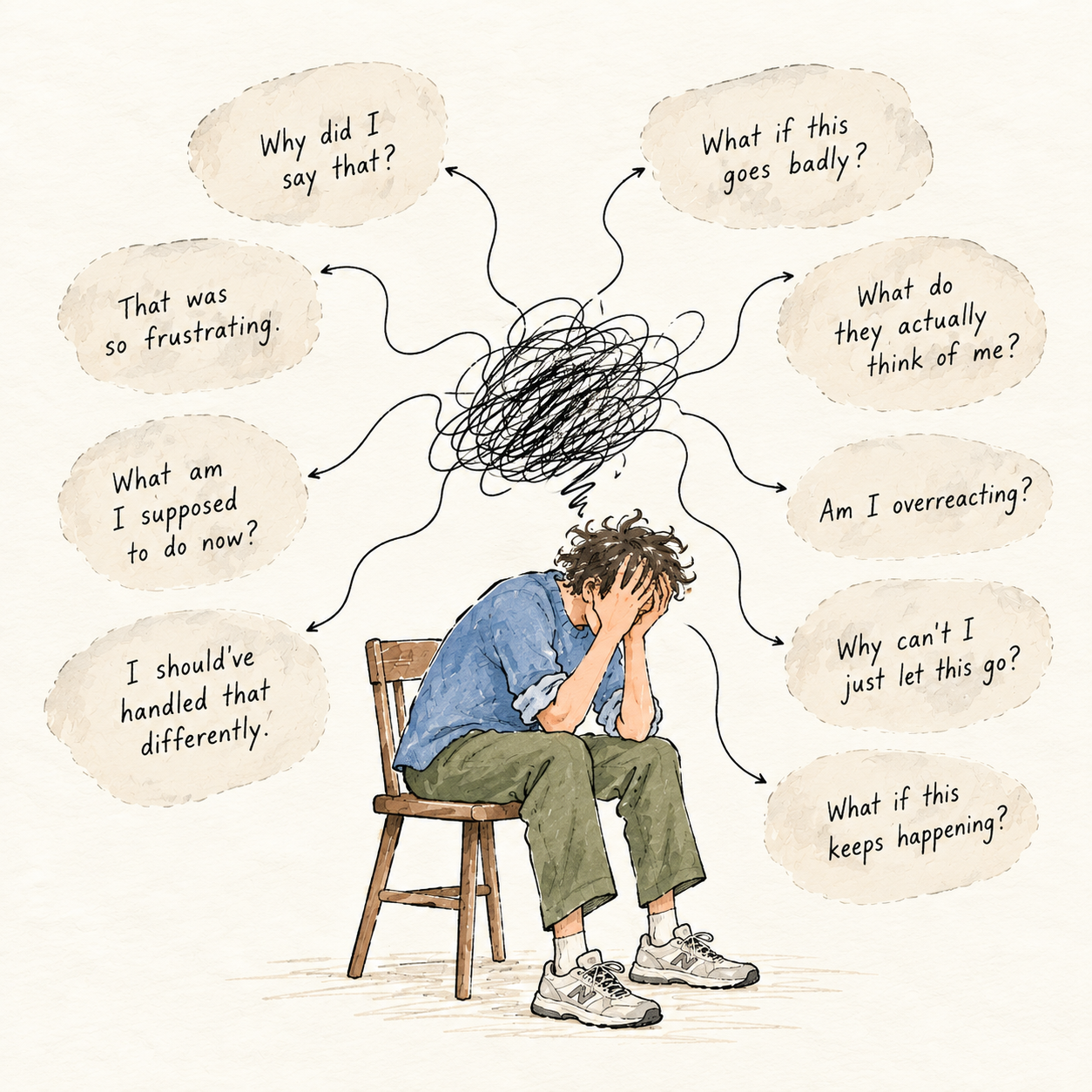
Your Mind Is in the Wrong Tense
Do you replay the past in your head, thinking about what you should have said or done differently? Or maybe your mind lives in the future. You rehearse conversations that haven't happened. Run through different scenarios. Anticipate what could go wrong and try to prepare for it before it does.
This is one of the tricky things about anxiety: it can make thinking feel like the solution. It can be tempting to indulge in either rumination or anticipation because it feels like our brain is doing productive. It feels like your brain is doing something. Rumination feels like understanding. Anticipation feels like preparing.
But hours, or even weeks later, you might find yourself in the exact same place.
The more anxious you feel, the more you think. And the more you think, the more there seems to be anxious about. Maybe you even have anxiety about your anxiety. You start to overthink your overthinking. All that thinking can pull you away from the only place you can actually do anything: the present.
What if anxiety isn't the problem?
Most of us assume that feeling anxious means something is wrong. So we try to get rid of it. Calm down. Stop thinking about it. Reassure ourselves that everything will be okay.
But anxiety exists for a reason. It helps us look ahead, anticipate what might happen, and prepare for things that matter to us. In fact, anxiety and hope have something important in common: both require us to imagine a future that hasn't happened yet.
The problem isn't necessarily that you feel anxious. It's what happens when anxiety stops helping you prepare for your life and starts preventing you from living it.
Maybe the goal isn't to become someone who never feels anxious. It's to become someone who knows what to do when anxiety shows up.

You can get better at anxiety.
You can learn to notice when anxiety is giving you useful information and when it's pulling you into another thought loop.
You can get better at feeling uncertain without needing to think your way to certainty. Or even needing complete certainty before following through with a decision. At letting anxiety exist without immediately trying to make it disappear. At staying present even when part of you wants to jump ten steps ahead.
You don't have to wait for anxiety to become smaller to become stronger.